
April 2026
This issue of Hydrocarbon Engineering begins with a timely look at the latest developments in the Middle East and North Africa (MENA) region. The issue then explores a number of pertinent topics, including site safety, decarbonisation pathways for downstream operations, project upgrades, sulfur removal, CCUS technology, and much more.
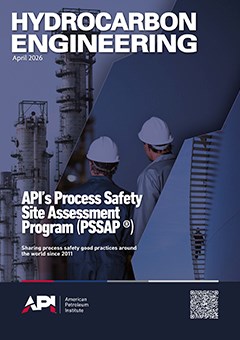
This month's front cover is brought to you by American Petroleum Institute (API).
Register for free »
Get started now for absolutely FREE, no credit card required.
Contents
Beyond borders
Gordon Cope, Contributing Editor, explores how countries across the Middle East and North Africa are safeguarding energy assets amid geopolitical tensions and economic troubles to ensure continued market success.
Strengthening process safety
Colin M. Frazier, American Petroleum Institute (API), discusses how proactive planning can help establish strong, prevention-focused safety systems within refineries.
Decarbonisation pathways for downstream operations
Juan Gomez Prado and Nenad Zecevic, KBR, explore how operators within refineries and petrochemical environments are best placed to view pathways to decarbonisation, rather than focusing wholly on net zero targets.
Reinventing refining
Robert Ohmes, Tracy Sadowski, and Scott Sayles, Becht, consider how operators can ensure operational performance and cost effectiveness amid a new energy reality.
Starting from scratch
Siebren Mellema, Worley Comprimo, suggests that operators should consider the potential benefits to ‘starting from scratch’ when undergoing process and project upgrades for petrochemical plants.
Standalone sulfur treatment
Veronica Irurzun Conner and Juan J. Gonzalez, Merichem Technologies, USA, explain why there are situations in which smaller, standalone sulfur removal units offer distinct advantages for refineries and petrochemical plants.
Recovering flare gas in Oman
Rieks de Rink, Joost Timmerman, and Jan Henk van Dijk, Paqell B.V., the Netherlands, alongside Maitham Shidi, Petroleum Development Oman (PDO), and David Street, SLB – Process Technologies and Solutions (PTS), USA, discuss the start-up and operation of a new biodesulfurisation unit for flare gas recovery in Oman.
Fit-for-purpose filtration
Neil Richards, PS Filter, Canada, stresses the importance of filtration systems for ensuring reliability in downstream refining and petrochemical operations.
Complex coking challenges
Logan Boatright, Neil Murch, and Bailey Stainsby, Tracerco, discuss how solid-state neutron backscatter measurements can provide real-time insight into foam and coke levels in delayed coking operations, improving visibility and supporting safer, more efficient drum control.
From injection to transportation
Cesar Martinez, Endress+Hauser, USA, considers the importance of CO2 measurement in oil and gas applications and pipeline transportation amid growing decarbonisation.
Control valves for carbon capture
Vera Vaskova and Vipin Das, Emerson, consider how the success of carbon capture projects depends on careful selection of proper control valves to address complex process challenges.
Maximising maintenance
Eric Sallee, OsecoElfab, explores how operators can maximise rupture disc service life through careful consideration of operating ratio, material compatibility, and modern disc technologies.
Advancing hydrogen reforming
Barinder Ghai, Alleima, explores the critical role pigtails play in steam methane reforming, with a focus on material selection for components.
Register for free »
Get started now for absolutely FREE, no credit card required.