
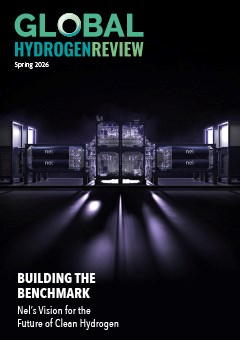
March 2026
This issue examines how hydrogen is shifting from ambition to real-world deployment, highlighting the technologies and strategies enabling scale. From the MENA region’s growing influence and the role of blue hydrogen in kickstarting markets, to advances in electrolysers, digitalisation, and automation, contributors explore how efficiency and cost challenges are being addressed. The edition also covers key developments in compression, infrastructure, and storage, alongside a broader industry shift toward practical, commercially viable projects that are accelerating the transition to a low-carbon hydrogen economy.
This month's front cover is brought to you by Nel Hydrogen.
Register for free »
Get started now for absolutely FREE, no credit card required.
Contents
Powering the future
Conrad Purcell, Shu Shu Wong, Kayley Rousell, and Ziv Gould, Haynes Boone, analyse how the Middle East and North Africa (MENA) region is becoming a prominent player in the green hydrogen market.
A scalable route to industrial decarbonisation
Phil Ingram, Johnson Matthey, argues that early deployment of blue hydrogen will help establish the infrastructure, demand, and revenue mechanisms for the broader hydrogen market.
The tide that lifts all boats
Kathy Ayers, Ph.D., Wilhelm Flinder, and Russell Morgan, Nel Hydrogen, outline why electrolyser innovation is for the collective good of the entire hydrogen economy.
Cracking the code for a low-carbon future
Nirav Shah, Evonik Catalysts, discusses how ammonia cracking can support a sustainable hydrogen economy by enabling efficient storage and transportation.
Ready, set, go!
Christopher Polaniecki, Honeywell, USA, explores solutions to digitally unlock the potential of green hydrogen and ammonia within the competitive landscape of the hydrogen industry.
From design to operational reliability
Jagadesh Donepudi and Michelle Wicmandy, KBC (A Yokogawa Company), discuss how digital twins can be used to improve operations in green hydrogen projects.
Making hydrogen cost-effective
David Meyer, Siemens, considers how automation, simulation, and machine learning can reduce hydrogen production costs and ensure its commercial future.
Next energy era control rooms
James Nyenhuis, Emerson, USA, outlines the importance of empowering operators with intuitive, exception-based visibility to enhance safety and scalability.
Hydrogen ambition meets infrastructure reality
Garry Hanmer, Atmos International, UK, explains why pipeline simulation is becoming essential for emerging hydrogen systems.
Hydrogen compression for tomorrow
Svitlana Snelder, Yann Ardouin, and Rens Hulstijn, Howden, A Chart Industries Company, explain how diaphragm compressors are being advanced to deliver reliable performance at high pressures and scaled hydrogen flows.
An alternative material for higher speeds
Frank Shoup, Manish Thorat, Brian Pettinato, Hanxiang Jin, and Derrick Bauer, Ebara Elliott Energy, explore the feasibility and impact of implementing an aluminium impeller for high-speed centrifugal compression.
Compressing under pressure
Michael Vidovitsch, HOERBIGER, considers how hydrogen compressors can be designed to maintain efficiency under high pressures as green hydrogen scales up.
Unlocking hidden revenue streams with turbomachinery
Daniel Patrick, Atlas Copco Gas and Process, USA, discusses how oxygen and pressure letdown recovery can create additional revenue sources from hydrogen production.
A pivot to pragmatism
Keigh Taylor, Black & Veatch, discusses the shift in the UK hydrogen market to focus on simple projects with long-term offtake.
Scaling the skies
Chris Dudfield, Intelligent Energy, UK, presents a scalable model to demonstrate closed-loop hydrogen integration and accelerate the deployment of fuel cells for aviation.
Liquid hydrogen storage solutions
Dr Barry Prince, Dr Rajendran Parthipan, and Dr Neil Glasson, Fabrum, explain why liquid hydrogen is the most viable low-carbon fuel for hard-to-abate sectors.
A hydrogen liquefaction system for all
Francesco Dioguardi, Stirling Cryogenics, the Netherlands, illustrates how established cryogenic principles can be applied in modern liquid hydrogen systems.
Register for free »
Get started now for absolutely FREE, no credit card required.