It is no secret that the path to the energy transition is a challenging one. In spite of this, proven solutions already exist that can significantly reduce the carbon intensity of how we generate power and heat, both essential to modern life.
This article explores how industrial heat pumps are emerging as a critical technology in supporting decarbonisation and supporting the shift away from fossil fuels while enabling more efficient and sustainable heat generation.
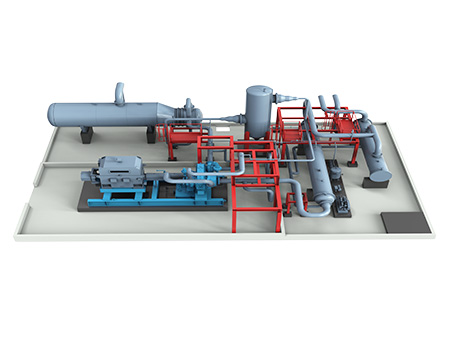
Long history
With their origins going back more than a century and a half, it is easy to understand why heat pumps are hardly seen as the newest, most cutting-edge technology. This, however, is part of their key attraction: heat-pump technology has been proven for decades, and with modern iterations they are more relevant than ever before. Much like today, heat pumps started to be more widely used during the early 20th century, surprisingly at a time when increasingly numbers of countries were desperate for cheap fossil fuels to power their industrialisation and modernisation efforts.
The first heat pumps installed on what could reasonably be considered a large scale came online in Switzerland in the 1930s. Interestingly, the motivation to develop and commission the technology was not a million miles from today’s: to rely much less on imported fossil fuels for power and heating. This first introduction of heat pumps was, however, during an age of fossil fuel dominance, when oil and gas were the overriding factor in powering our homes, industries and businesses. This has only begun to be challenged in the last few decades.
Though used intermittently since the 1930s, the availability of cheap fossil fuels meant heat pumps were pretty much sidelined across both the developed and developing worlds. One notable exception was Sweden, which (due to price volatility in the 1960s and 1970s) made a conscious decision to move away from the dependence on fossil fuels. By the 1980s, the country was on its way to becoming a leader in employing heat-pump technology and reducing CO2 emissions. Two heat pumps with Atlas Copco Gas and Process compressors installed in Stockholm's heating network date from that period. Both have 40 MW thermal output and save 90 000 tpy of CO2 emissions (compared to the previous use of heating oil).
The fridge analogy
Technically, heat pumps have an operational principle that is similar to that of a normal household refrigerator. Basically, they have a refrigerant (a liquefiable gas) that is evaporated in a cyclic process at low pressure. A compressor then compresses the refrigerant, and it is then condensed at higher pressure. A pressure-reduction component, usually an expansion valve, closing the cycle.
Regarding how they work is equally straight forward: the refrigerant absorbs heat during the evaporation process, just as it does from inside a refrigerator or from a low-temperature environmental or process heat source. Once at a high pressure and high temperature, after compression the gaseous refrigerant condenses. The heat needs to go somewhere, and in an industrial setting, this heat can be used for something useful, such as district heating or process heat.
Depending on the context, if the electricity invested is carbon-free, then the heat-pump system will subsequently deliver a blend of carbon-free recovered and electric heat. Nonetheless, it is worth noting that should the heat pump be driven with electric power from a fossil fuel powerplant; its heat would always have a lower carbon intensity than that derived from the same amount of fossil-fuel heat.
COP and turbocompressor technology
The brilliance of the basic heat pump is that the heat is loaded into a refrigerant and raised to a higher temperature level using additional energy. The relationship between the power to drive the heat pump and the thermal output is important. Roughly around two-to-four kWh of heat can be pumped with 1 kWh of electricity. This ratio of electricity used to usable heat is termed the coefficient of performance (COP). We can compare an electric heater, which has a COP of 1, with the electrolysis and combustion of hydrogen, which typically has a COP of 0.6 (mainly due to losses in electrolysis). What this shows us is that a heat pump generates much more usable heat from the same amount of electricity compared to many other technologies.
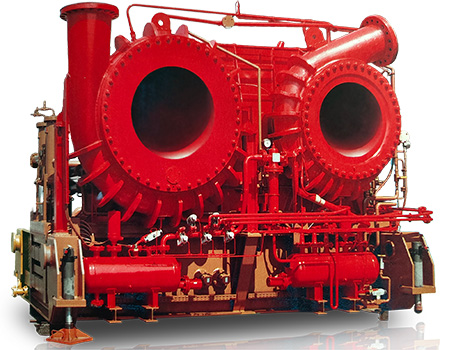
The heat pump owes much to the technology employed. Larger outputs in heat-pump systems generally require high-performance turbomachinery, while continuously operating production processes in industry require maximum reliability and economy. At the heart of the success of heat pumps are integrally geared turbocompressors (IGCs), machines that can be configured to match customer requirements and optimised according to individual performance, reliability, and economic criterion.
With up to eight individual compressor stages on a gearbox, flexibility is a fundamental aspect of the design of integrally geared turbocompressors, and they allow for the possibility of multiple interstage cooling. Inlet guide vanes (IGVs) precisely control compressor stages and act to compensate for fluctuations in heat demand. Moreover, expensive power electronics for speed control are not required because of an entirely mechanical control system. In fact, in critical applications in large production plants, a simple, mechanical power and capacity control is often the preferred option.
Natural refrigerants
Clearly, heat pumps rely on refrigerants in order to achieve high COP values, and compressors are designed to work with a specific refrigerant. With hydrofluorocarbons (HFCs) banned for environmental reasons, natural refrigerants are nowadays preferred, future proofing the machine (as the refrigerant would not be banned at a later date). This is crucial when one understands that the normal service life of Atlas Copco Gas and Process compressors is more than three decades. In fact, on the back of robust designs and good aftermarket service, some Atlas Copco Gas and Process compressors installed in the 1980s have had their lives extended and will still continue for a further 15 years, well into the 2030s. Atlas Copco Gas and Process heat pump compressors use natural refrigerants, specifically hydrocarbons, water, inert gases (nitrogen and argon) and carbon dioxide (though machines with HFCs and ammonia as the working fluids are also available).
Applications
The type of modern heat-pump systems employed today provide steam directly at pressures up to 5 barg (80 PSIG) without further steam compression. Systems in the double-digit megawatt class have been in operation since the 1980s and are still running today, such as for providing district heating to networks in Sweden.
Reflecting their diverse applications, heat pumps can be employed in the production of bioethanol and sugar, for instance. In the former, heat from the condensation of the ethanol is transferred into the circuit of a heat pump, with the heat from the distillation process fed back in as usable heat. A system with a temperature rise from 70°C to 110°C can achieve a COP of 4, while thermal outputs of up to approximately 50 MW can be achieved for each machine. In the latter example, sugar production, the waste heat can be used several times to heat downstream processes. It eventually becomes waste heat at approximately 50°C. A heat pump with an oil-free integrally geared turbocompressor can comfortably achieve a temperature rise of 50°C to 140°C to produce the required steam at 2.5 bar, with a resultant COP value of a respectable 3.
The utilisation of industrial heat pumps has in recent years expanded, so much so that they are now employed at carbon capture, utilisation and storage (CCUS) and direct-air capture CO2 plants. Today’s CCUS technologies involve many process steps that require lots of heat, such as thermal desorption of adsorbed CO2 and stripping processes of amine solutions, most involving steam at low pressure. There are additionally low-temperature energy streams of CO2-emitters (heat of flue gases, plant cooling water, and so on), or even the CO2 export gas compressor waste heat, that can act as heat sources for an industrial heat pump.
The return of the heat pump
The return of heat pumps has been welcomed not just in industrial settings but nowadays also in domestic settings. Whether in district heating and CCUS systems or in bioethanol and sugar production, across various industries heat pumps are becoming familiar as a proven technology that can boost a company’s decarbonisation ambitions. This return of the heat pump has been long coming but this time it is here to stay, helping to replace fossil fuels and meet climate goals.
For more information about Atlas Copco Gas and Process click here.